Drive down Kahala Avenue on a quiet weekday afternoon and you'll pass the low hedges and iron gates of Waialae Country Club long before you see the ocean past it. For nearly sixty years, one week every January turned this stretch of coastline into a broadcast backdrop, with grandstands rising where the ninth fairway usually sits empty. That week is changing. And if you're comparing this pocket of East Oʻahu against other Honolulu neighborhoods right now, the golf tournament's new status matters less than what it reveals about a number you've probably already looked at: the median price.
What Actually Happened at Waialae
The Sony Open played its final edition as a full PGA Tour event from January 12 to 18, 2026, with Chris Gotterup taking the trophy at Waialae Country Club, a course the club has hosted continuously since 1971. On April 20, 2026, the PGA Tour confirmed it was ending its Hawaii swing for the 2027 season, pulling both The Sentry at Kapalua and the Sony Open from the main tour calendar. The Sentry's exit traced back to drought and water conservation problems on Maui. The Sony Open's situation was different. Waialae drew respectable crowds from Honolulu's denser population, but according to Golf Digest's reporting on the decision, the tournament never became the kind of revenue engine the Tour's mainland stops had become, and the cost of staging a Hawaii swing outweighed what it returned.
On July 1, 2026, the Tour confirmed where the Sony Open lands next: the PGA Tour Champions senior circuit, under a new name, the Sony Championship Hawaii, with a $3 million purse starting in 2027.
Local reaction was immediate and mostly unhappy. Golf analyst Mark Rolfing, discussing the decision on Hawaii News Now, described himself as "half angry and half disappointed." Corey Kozuma, a pro at Mid-Pacific Country Club who competed in this year's field, talked about growing up watching the tournament as a kid and what it meant to finally play in it. Friends of Hawaii Charities, the nonprofit that has run the Sony Open's philanthropic arm, has generated more than $26 million for local causes over the tournament's run as a title sponsor since 1998.
Statewide, the January 2026 Sony Open alone drew roughly 16,000 out-of-state visitors and an estimated $54 million in direct spending, according to figures cited by Hawaii tourism officials.
That's real money, and real disappointment. None of it, though, has ever had a documented connection to what a house on Kahala Avenue is worth.
The Membership Wall Was Always There
Here's the part that gets lost in the tournament coverage: owning property near Waialae Country Club has never meant access to it. Membership is by invitation from existing members only, a private process that runs entirely separate from any real estate transaction. According to a general manager staffing profile the club itself circulated, Waialae carries an initiation fee of roughly $70,000 and counts approximately 1,165 members across its categories. Guests, even those invited by a member, must be accompanied at all times.
The club was founded in 1927 by a group of Honolulu businessmen, with its Seth Raynor and Charles Banks-designed course opening for play that February. Nearly a century later, the gate has stayed just as closed to the general public, tournament or no tournament. A buyer who assumes a home across from the fairway comes with playing privileges is working from a false premise that has nothing to do with the PGA Tour's schedule.
The Number That's Been Misleading You
Here's where it gets more useful for anyone actually comparing neighborhoods. Portals and market reports often group this area under a single label, "Waialae-Kahala," and that label spans an enormous range of housing stock that has almost nothing in common beyond a shared zip code.
| What's included under "Waialae-Kahala" | Example | Price point |
|---|---|---|
| Older concrete condo, Waialae Avenue corridor | 2BR/2BA unit at 4300 Waialae Avenue, sold June 2026 | $95,000 |
| Condo currently listed under the broader boundary | Recent median asking price across active listings | Roughly $600,000 |
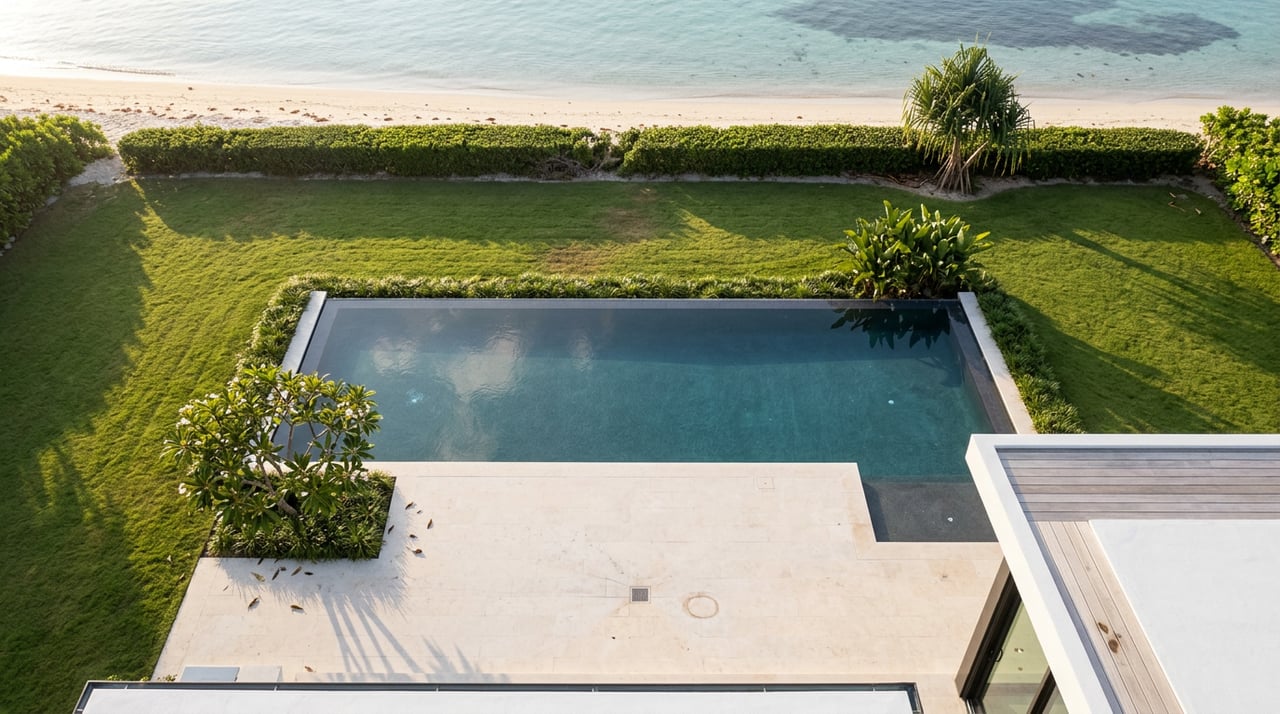
| Raw oceanfront land, Kahala Avenue itself | Parcel exceeding 45,000 square feet with more than 100 feet of direct beach frontage | Priced as land alone, starting near $1.5 million |
| Built oceanfront estate, Kahala Avenue | Fully developed beachfront residence | Into the $20 million range and beyond |
A $95,000 condo sale and a $20 million beachfront estate sale can both technically fall inside the same "Waialae-Kahala" median calculation. When you see a single median price quoted for this area, ask what's actually being averaged before you use it to compare against Kailua, Kahala Kua, or any other neighborhood on your list. It is very often not comparing like to like.
What Actually Sets the Price Here
If the tournament's status and the neighborhood label both fail to explain value, what does? Three things, consistently, based on how this stretch of coast has been priced for decades.
Street matters more than zip code. Kahala Avenue itself, running along the ocean, commands the highest prices in the area. Aukai Avenue and Kolohala Avenue, set back slightly but still within the neighborhood's core, follow close behind, prized in part for being wide and quiet with little through traffic. Move inland toward the Waialae Avenue corridor or the older condo buildings near Kahala Mall, and pricing drops sharply, sometimes by a factor of ten or more, despite falling under the same broad neighborhood name.
Zoning caps density on purpose. Kahala's residential lots are zoned R-10 or R-20, larger minimum lot sizes than much of urban Honolulu allows. A long-standing community association has consistently opposed variance requests that would allow anything beyond single-family use. That resistance has kept the area's lot sizes and low density intact for generations, which is a large part of why land here, even unbuilt land, carries a premium regardless of what's happening at the country club a few blocks away.
Beach frontage is scarce and non-negotiable. Direct beach access along Kahala Avenue is limited to a specific run of properties, and that scarcity, not tournament week, has always been the ceiling-setter for the neighborhood's highest sales.
There's also a smaller enclave worth knowing about if you're cross-shopping: the Waialae Golf Course area, tucked between the Kahala Hotel & Resort and Kalanianaole Highway, where single-story homes ring the course itself. It offers privacy and green views but sits at a different price tier than oceanfront Kahala Avenue, another reminder that proximity to the club is not one uniform thing.
What This Means If You're Comparing Neighborhoods Right Now
Oʻahu's broader single-family market gives useful context, even if it won't tell you what a specific Kahala Avenue lot is worth. In July 2026, single-family homes across the island sold in a median of roughly two weeks, with about a third of sales closing above the original asking price, according to figures compiled from Honolulu Board of REALTORS® data. The islandwide median climbed to somewhere around $1.2 million, up roughly 13 to 14 percent from a year earlier. That's a competitive market by any measure, and it means buyers eyeing this corridor should expect to move quickly once they've identified the right street and lot, not the right tournament calendar.
A few practical habits follow from all of this:
- Ask which street a listing sits on before you look at its price, not after.
- Confirm the zoning designation and lot size directly, since R-10 and R-20 carry real, lasting implications for what can be built around a property.
- If club access matters to your decision, treat it as its own separate inquiry with the club, not an assumption baked into a real estate closing.
- When a median price is quoted for "Waialae-Kahala" or any similarly broad label, ask what property types and streets are actually included in that number before using it to compare against another neighborhood.
A Few Direct Questions
Will the PGA Tour's departure lower home values near Waialae Country Club? There's no established or documented relationship between the tournament's tour status and property values in this area. The neighborhood's pricing has rested on lot size, beach frontage, and zoning for decades, all of which remain unchanged by where the Sony Open sits on next year's golf calendar.
If I buy on Kahala Avenue, can I expect to join Waialae Country Club? No. Membership is by invitation from current members, a private process handled entirely by the club and unrelated to any property purchase, regardless of how close the home sits to the course.
If you're weighing Kahala Avenue against another East Oʻahu street, or trying to make sense of a median price that doesn't seem to match what you're actually seeing listed, that's exactly the kind of conversation worth having before you make an offer. Francein Hansen works this corridor closely enough to tell you which number in a listing actually matters and which one is just noise. Schedule a strategy session to talk through what you're comparing and why.